
$1000+ Dropshipping Products Anyone Can Sell - Industrial Sensors
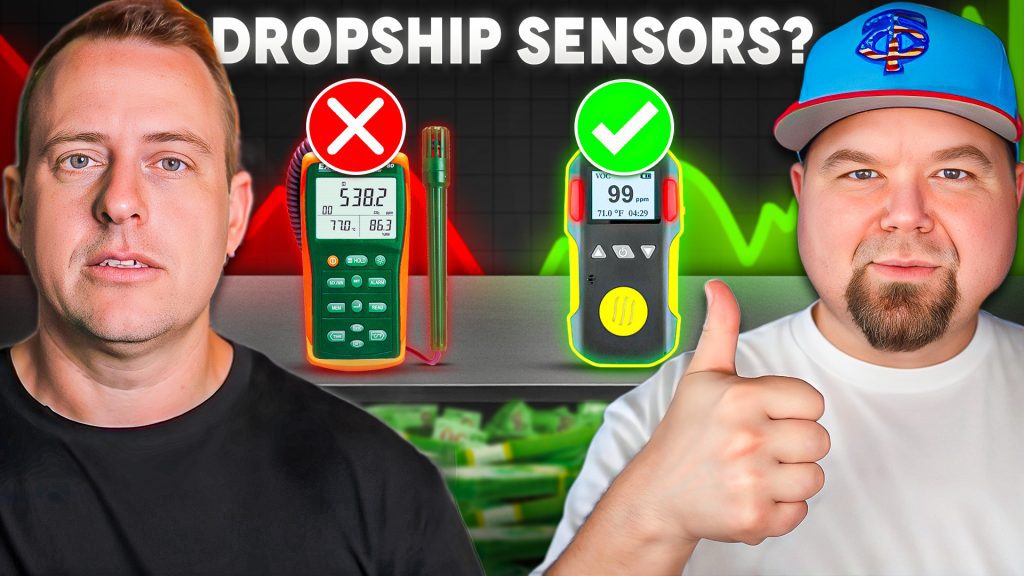
If you asked a room full of dropshippers to define the “holy grail,” most would say the same thing: find a high‑ticket product—well over $1,000—that fits in a small box and ships inexpensively via UPS or the postal service.
In this episode of The Dropship Podcast we discuss a fresh idea that fits this description that NO ONE is talking about. Will it work?
Powered by RedCircle
You Can Get Started Right Now Dropshipping These Products...
The initial spark came from an air‑purifier business that routinely hears from customers about air quality problems—CO₂ levels, VOCs (those “new paint” or “new couch” smells), mold concerns, and more.
The simple question followed: if people care about these issues, aren’t there sensors that measure them?
That curiosity led to a rabbit hole of specialized instrumentation: solar‑radiation sensors that look like tiny UFOs, lightning detectors used by farmers, utilities, and public pools, and a long list of niche devices that quietly power decisions in labs, factories, and municipalities.
The striking bit is that many of these sensors are compact and often retail for well over a thousand dollars.
Sure, you’ll find cheap versions on marketplaces that probably underperform, but there’s a bona fide tier of professional‑grade instruments from established brands that command premium pricing—and ship in very small boxes.
Start researching and you’ll see prices all over the map.
Take “VOC sensor” as an example: you’ll find $4 trinkets beside handheld instruments in the $800–$2,000 range, and then serious industrial monitors at several thousand dollars.
One vendor catalog surfaced handheld indoor‑air‑quality units around $820–$3,000, a dedicated dust monitor at roughly $5,500, and a full‑blown indoor‑air‑quality monitor near $7,500—all of which would ride to the buyer in a shoebox‑sized package.
That spread can be confusing. The key is use case. Consider “oxygen sensor”: in automotive settings it can be a $30–$60 part; in industrial environments, an “oxygen sensor” can be a box the size of a dictionary that costs $3,500.
Same name, totally different applications and buyer expectations. When you see wide price variance, ignore the low‑end consumer use cases and zoom in on the professional/industrial tier your business actually wants to serve.
With sensors, you don’t need dozens of brands per product type. A rule of thumb from the conversation: if you can identify three to five legitimate brands or suppliers for each sensor type you plan to carry, you’re in business.
You’ll also find overlap—one manufacturer may produce multiple sensor types (say, pH/ORP, dissolved oxygen, and turbidity), while another covers different parts of the catalog.
You’re building a coherent, B2B‑leaning storefront more than you’re chasing a single SKU.
Crucially, shipping is a non‑issue. Nearly everything in this category is small and light. That means you can focus your energy on supplier relationships, merchandising, and sales enablement—not freight logistics.
Here’s a taste of the breadth discussed:
Air and weather: CO₂ meters, VOC detectors, solar‑radiation sensors, lightning detectors.
Water and lab: pH and ORP probes, dissolved‑oxygen sensors, nitrate sensors, oil‑in‑water sensors, conductivity and turbidity sensors (including bypass models), and even peristaltic pumps.
Flow and materials: impeller flow sensors and penetrometers (devices that measure the force required to penetrate a material—useful in product testing and quality control).
There are also “hub” products that sit between the field sensors and the user—units that accept inputs from multiple sensors and manage them together. That means accessory and integration opportunities right alongside the core instruments.
“But I’m not technical…”—why that’s not a deal‑breaker…
A common blocker is perceived complexity. Many would‑be sellers think, “I don’t even know what these things do—how could I sell them?”
The truth is you don’t need to be a scientist to provide great service. Ben started in a technical niche (3D printers) knowing almost nothing. When tough questions came in, he’d take the details, research the answer, and call back.
Competence compounds quickly when you’re motivated by real customers and real orders.
Mid‑ticket can become high‑ticket through quantity: the vape detector angle…
Not every promising device breaks $1,000 on a per‑unit basis, and that’s okay if the natural order size is large. Vape detectors for schools are a good example.
While some units land around $500–$1,000, buyers rarely purchase a single device. Schools outfit multiple bathrooms; hotels, Airbnbs, workplaces, and property managers may deploy detectors across many rooms or locations.
Just like selling architectural light fixtures to a restaurant—$300 each, but 20 in a single order—the cart total quickly becomes a high‑ticket sale.
There also appears to be a limited number of strong suppliers in vape detection today, which hints at white‑label or private‑label potential for operators who can market better than incumbents and coordinate manufacturing.
How to decide if sensors are right for you
Boiled down, the go/no‑go looks like this:
1. Pick your sub‑niches (air quality, water quality, lab/process, environmental monitoring).
2. Run a supplier census for each sensor type you plan to carry. If you can name three to five credible brands or distributors in that type, it passes.
3. Segment your buyers (labs, HVAC contractors, municipalities, schools, industrial plants) and collect the common jobs‑to‑be‑done they share.
4. Merchandise for clarity —organize by application and measurement, and highlight handheld vs. installed vs. multi‑input controllers.
5. Plan for sales enablement: spec sheets, comparison charts, quote workflows, and knowledgeable responses (even if you need to research before you reply).
The bottom line: From a dropshipping perspective, the industrial sensor space is surprisingly untouched.
It’s B2B‑leaning, high intent, full of compact, high‑value SKUs, and it lends itself to repeat orders and multi‑unit carts.
Yes, the terminology can feel intimidating at first, but that’s exactly why the field is wide open: most people stop at “I don’t know what that is.”
If you’re willing to go a layer deeper—validate suppliers, learn the basics of a few sensor families, and show up with real service—you may have found the rare niche that looks small on the shelf but big on the invoice.
If this sounds like it could be up your alley – go for it!
If you’d like to get our complete plan for finding hundreds of niche and product ideas that can work over and over again – grab the Passion To Profit Blueprint today for just $27.
Want to start your own high ticket dropshipping business?
Watch this FREE, on-demand training session that will uncover the exact steps you need to take to launch your first high ticket dropshipping business in the next 30 days.
Ready To Start Your Own High Ticket Dropshipping Business?
Book your complimentary call with one of our high ticket dropshipping experts who are also successfully running a business right now and are Dropship Breakthru members, to learn more about getting started.

© Dropship Breakthru LLC 2026
