
This Dropshipper Paid $5K To Attend Hormozi's Event
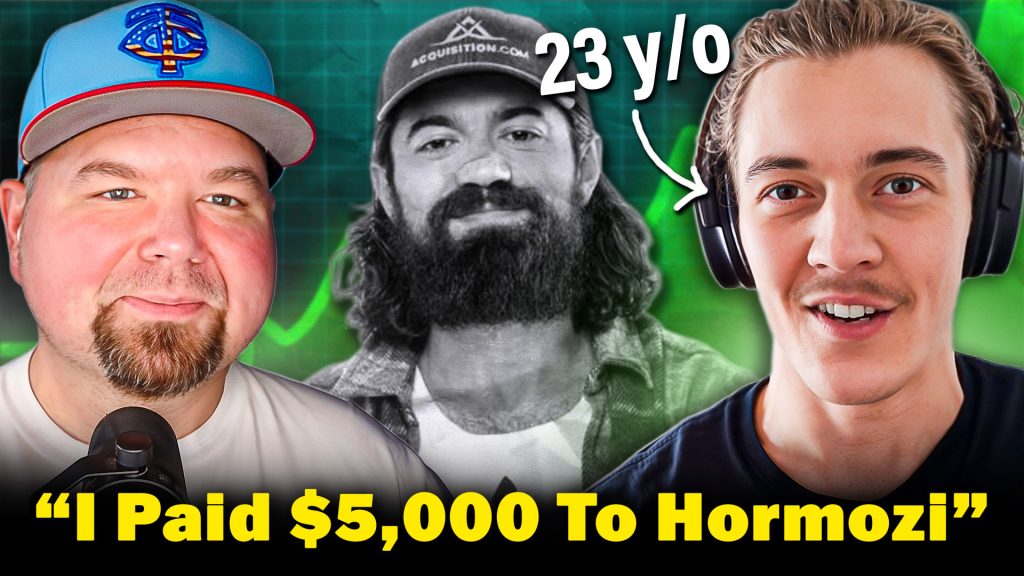
At 23, Matt Gemkow is crushing the dropshipping stereotype…
He’s on track for $4 million in revenue selling high-ticket gym equipment, and he just invested $5,000 to attend Alex Hormozi’s exclusive Vegas mastermind.
In this episode, Matt reveals the game-changing insights he gained from Hormozi’s “Value Acceleration Method” including how to identify your true business constraints, why targeting “whale” customers beats chasing small sales, and the three-step marketing approach that’s transforming his business.
Powered by RedCircle
What Matt Learned About Business From Alex Hormozi
Ben (00:00): Matt, you just dropped $5,000 to hang with Alex Hormozi in Vegas. Most people think dropshippers are broke—teenagers selling $10 phone cases from their mom’s basement. What the hell were you doing there?
Matt (00:09): Just buying information—cheat‑coding the system. You know me.
Ben (00:16): Set the scene for me. What was the caliber of people at the event? What were your first impressions walking into the room?
Matt (00:21): So I grab an Uber from my hotel in Vegas. I pull up, and the people person—his name’s Frank—literally comes to my Uber, opens the door, and welcomes me out. Then I walk into the crowd. There’s a line outside the building, a big Acquisition.com sign, and the first people I meet are like, “Hey man, how’s it going?”
There were a bunch of other young guys—actually close to my age, which was surprising. There were definitely some smaller businesses there—kids my age with all different types of businesses. You walk through security, you get in there, and you’re welcomed by everyone in their beautiful suits. They had a nice breakfast—which was fantastic, by the way; the food was excellent.
I mingled with other business owners, tried meeting as many people as I could, and then the event starts. It’s a real sharp schedule—they have a major agenda to get to.
Ben (01:22): Before we dive into what you learned—because I want to know—can I address the elephant in the room? I’m sure there are people watching who’ve never seen you or me before. You’re 22 years old, you’re absolutely jacked, and you’re making serious money dropshipping. That’s not the stereotype. So how long have you been doing this, Matt?
Matt (01:41): I’ve been at this business specifically for four years now.
Ben (01:45): What does your business look like? Are you comfortable sharing revenue or profit?
Matt (01:50): Yeah. I should clear at least $4 million this year. For 2025 I was shooting for five; it’s still possible, but definitely four for sure. Pretty decent profit for the income I need—and I’m trying to learn, be a student of the game. Profit is how you measure that, but I make good money. So $4 million on the year with close to 8%–10% profit.
Ben (02:22): We love dropshipping on this channel—we’re all about high‑ticket dropshipping. What was the reaction when you started introducing yourself to people in Vegas? You probably said “I’m a retailer” and maybe didn’t even drop the word “dropshipping,” given the stigma from low‑ticket dropshipping. You said there were a lot of people your age, which is amazing. When you tell people what you do and your age at an event like that, what’s the reaction?
Matt (02:47): Two things. On age: people are like, “Wow, you’re so young. I was an idiot at 23—I wish I could go back.” I got lucky; I started very young, and I’m glad I did.
Second, the types of businesses there—probably 70% were B2B services. I got a view into all those companies that hit you with cold emails: “Can I do this? Can I give you a free audit?” I saw the variety of other business models—different ways to add value. That was refreshing. But yeah, 70% were B2B services in one form or another.
Ben (03:51): You’re a fitness guy. Your business is in the fitness space. Was the rest of the room like that? Were you the only fitness person? Any light‑bulb moments seeing who else was there?
Matt (04:07): There was one other fitness‑equipment guy—the session leads told me that. I tried finding him. I went up to the most jacked guys I could find like, “You must be the fitness‑equipment guy.” They’re like, “No, I sell B2B SEO services.”
So I didn’t actually meet the other fitness‑equipment guy. As far as fitness goes, I think it was just me and one other person in terms of equipment—or any fitness‑industry business—as far as I know.
Ben (04:49): Walk me through it. I assume a lot of the room was B2B, which makes sense for Acquisition.com. You’re one of the standouts doing something completely different—let alone dropshipping, with the stigma that comes with it. What did you learn? Biggest takeaways?
Before this call you said you went in with big expectations and they were exceeded—which is not normal. Most people meet their “guru” and come home disappointed. You had a different experience. Talk me through the biggest takeaways and how you’ll apply them to your business.
Matt (05:38): The event is two days. Day one is fundamental business education. I’d heard a lot of the terms, but the way they structure it—they call it the Value Acceleration Method—is the streamlined approach they take with every company they acquire. How do you make a valuable company? The answer is enterprise value, and there are a few ways to increase it.
Day one was talks after talks, lunch breaks—service was spectacular. They’d bring you drinks before you knew you needed one. We followed a workbook that laid out everything they’d cover, and we did exercises: What’s important and in what order?
A big thing they said: solve the right problem at the right time. To do that, you need to know your constraint. The method focuses the business on its current constraint—prioritize time, resources, and people toward that one constraint; then the business grows until the next constraint. It was a long day—8:30 to 6:30—nonstop aside from lunch, and packed with value.
Ben (07:34): How do you determine your constraints? Give the listener a quick walkthrough. How would you identify constraints in your business, and how will you attack them? If you’re willing, share your constraints in your e‑commerce business.
Matt (07:50): In my business it wasn’t immediately clear—which they’re fine with. They ask one question when someone doesn’t know: Are you supply‑constrained or demand‑constrained?
How you find out: if I doubled your business today, would something immediately break? I got asked that by every expert. Honestly, it depends who I sell to. If I sell to a whale, nothing breaks—inventory, people, processes. No stress. If I sell to minnows, things start breaking: out‑of‑stock cancellations, damaged deliveries, more returns.
So I had to answer “who” first. For the right customer, if you doubled my business tomorrow, nothing breaks. That means I’m demand‑constrained—I need more of the right customers and to do the things that get more of them.
Ben (09:30): Someone’s thinking, “No kidding—you need more customers.” But the “who” makes sense. In high‑ticket dropshipping you’re not holding inventory; you’re dealing with reputable suppliers, so some issues common in e‑commerce don’t hit you. You don’t have the same cash‑conversion‑cycle headaches. That simplifies the questions you ask when you’re in a room like this.
So you identified the who. If you double the “Joe in his garage” orders, you might have issues. Double the “small‑gym Sally” orders, your team can handle it. No constraints there. Accurate?
Matt (10:46): One hundred percent accurate.
Ben (10:48): Where do you go from here? You probably could’ve reached the “whales over onesie‑twosies” conclusion before, but now it’s clear. What’s next?
Matt (11:03): I had some ideas—and I like asking others. If you know who you want to sell to, what are you going to sell them? I’ve got that ironed out—gym equipment. Can you play with the offer? Bundles? Continuity? That’s fun, but the constraint is marketing.
In high‑ticket dropshipping, search (Google/Microsoft/Yahoo—even ChatGPT discovery) is the primary initial channel. By nature, it brings a massive mix of customers. I get one over here, one over there—varied spend and timing.
The biggest takeaway—and every expert said this—be intentional. Market to that person: your ICP, the right customer who’s in position to purchase. Instead of reacting to inbound search, flip it and intentionally target the accounts and people you want.
Ben (12:55): Was the advice to do one or the other—or, as Gary Vee says, “and”?
Matt (13:02): That was a sticking point for me—“one product, one avatar, one channel.” He means to $1M a month, not a year, before you add another channel.
They reframed it: think about the most effective way to apply your resources to get the best outcome. For me—commercial buyers—search is good. They recommended ways to optimize it and keep it going because it’s profitable. I have steps written down to make search work better for those people, and then there’s the landscape of hunting the right people intentionally.
Ben (14:18): I want to hear more about the latter. We’ve talked a lot about Google Ads on this channel. For listeners who don’t know you, what do you sell? Price points, categories, and your avatar—who are we targeting, and what are they buying?
Matt (14:50): I sell gym equipment and recovery solutions. Average order value is about $2,500 across ~2,000 products in six major categories. Roughly 150 customers a month, various sizes. A nice commercial order ranges from $20,000 to $100,000.
$2,500 AOV isn’t bad—about $550 profit per sale on average. But by avatar it gets interesting: whales have $10K+ AOV. Finding more of those businesses in the right position is the goal.
Ben (15:58): You’re following what we teach—sell products over $1,000. A $2,500 AOV is amazing. When whales come—$10K, $20K, $100K—the process is the same, with more consultative service.
People will ask: how do you position against others selling the same stuff—big‑box stores and Amazon? How do you compete?
Matt (16:35): Fair question. The internet is big. On Amazon, no one’s there to help when things inevitably go wrong. That’s the easiest sell:
If you buy on Amazon, you won’t get updates. You’ll order and it’s out of stock for two weeks. You think you got scammed and end up asking for a refund. Versus a specialty retailer/distributor: if you call, we answer; email, we answer; live chat, we answer. Ask any product question—we have answers. No unanswered questions, no unanswered update requests. On service alone we beat Amazon—and honestly 50%–80% of online competitors—by having people who answer and are product experts.
Ben (17:44): But you’re a product expert, right? You’re young but yoked. Your fitness background must help with credibility. I assume you hire people who understand this stuff too. Does that set you apart—not only answering the phone, but actually knowing what you’re talking about?
Matt (18:08): I learned something at the event that confirmed what I’d done accidentally. How you should hire for sales (their opinion—and now mine): three things—Person, Process, Product, in that order.
Person: traits, values, hunger, culture fit.
Process: can they do the job—sales or service?
Product: last. We’re not concerned about product knowledge until we know they’re the right person who can follow the process. We can teach the products faster than sales from zero.
So I hire (and will continue to hire) for role experience more than fitness knowledge. If you’re listening and don’t know much about your products, that’s not a big problem. Learn the process first; product/domain knowledge follows quickly.
Ben (19:29): You know me—I’m a big EOS fan: right person, right seat. Feels fundamental. Is this just old stuff in a new wrapper that finally clicked for you?
Matt (20:07): Absolutely. It’s fundamental and applies to any business—dropshipping, services, brick‑and‑mortar. That’s why they teach it—it’s universal.
Ben (20:31): Back to whales. Who are they—big gym owners? How are we going after them? We narrowed constraints to “whales,” and current marketing isn’t serving that. How do we plant a big flag that says “we serve whales”?
Matt (20:59): Step one: optimize what I have to attract more whales and gradually say no to everyone else—which is hard when a credit card is waving at you.
From there, they gave me three paths:
1) Account‑based sales: targeted outreach to specific accounts—corporate offices, warehouses, apartments, hotel chains. Not big‑box gyms (they have contracts with the biggest brands). These verticals are ripe. Build relationships and offer a catalog that serves their end users.
2) LinkedIn content (we’ll get to that).
3) Bulk cold outreach (we’ll get to that).
Ben (22:45): On #1, is that cold outreach—Apollo, scrapers, email, phone? Any tips on finding the right contact at, say, a hotel chain?
Matt (23:15): It’s cold, but highly personalized—relationship‑based sales. You don’t need thousands of touches like in bulk. Meet the right person or reach the right person who actually needs what you sell. Highly tailored messages to a specific decision‑maker.
Ben (24:05): Are you straight cold‑calling, doing research to personalize, sending gifts (Giftology‑style) so they open the box and notice you? What’s the plan?
Matt (24:23): They mentioned that exact book. Channels: LinkedIn, email, phone—every way you can contact the person, consistently, adding value (not spam). You can also reach out to others in the company who can get you to the decision‑maker. Same muscle as supplier outreach, funny enough.
Ben (25:12): I can hear someone saying, “Great, I found jim@xhotel.com—now what?” A box gets opened; emails get deleted. What’s your plan?
Matt (25:53): Giftology came up—so thoughtful, personalized gifts can open doors. Combine that with multi‑channel follow‑up.
Ben (26:04): What’s step two?
Matt (26:06): Step two is LinkedIn content. I’m already on LinkedIn for outreach, but having a presence makes outreach more effective. Right now it’s just the website, shopping ads, text ads, and various blogs.
I’ll post content with hooks and real value tailored to the target avatars—customer testimonials that match who I’m targeting, industry insights, content they’ll care about. That will attract customers by itself and give me more surface area for outreach. You can even layer in LinkedIn ads later.
Ben (27:17): Love it. I presented on this at our first live event. Create targeted content that attracts the people who care. You mentioned they told you to build a personal brand—that ties in here, right?
Matt (28:47): Yeah—it’s interest‑based media, not generic social media. Personal brand is non‑negotiable—not just to generate customers but to attract talent. Be transparent and authentic; people who vibe with your brand will want to work with you.
Ben (29:34): Lead by example—how did that show up at Acquisition.com in Vegas?
Matt (29:42): They asked: “How many of you follow the Acquisition.com Instagram?” Nobody raised a hand. We all follow Hormozi, but we know Acquisition.com. The personal brand drives the talent—and the talent was insane: multi‑seven‑figure exit founders, folks from BlackRock, Starbucks marketing, etc.
Every presenter was sharp and could answer any question on the spot. They had specialists—marketing, strategy, ops, people. Even the hospitality staff were top‑tier. Superb across the board.
Ben (31:25): So you tie that to personal brand and values (right person, right seat). Which mattered more?
Matt (31:42): Not sure what comes first. Hormozi’s personal brand likely attracts talent; values keep it aligned and scalable. Brand ≠ values, but brand draws people in; values govern decision‑making and culture.
Ben (32:16): You see it with Elon, too—polarizing but attracts a certain kind of talent. So what’s “special about Matt” that will attract other Matts? How will you put yourself out there to draw talent?
Matt (33:15): Thank you. I asked the same thing: what do I post to build a productive personal brand? They said: be transparent. Have your employees interview you; record SOPs; film what you’re already doing and post it—authentically. So I’ll do what I already do, but with a camera. Simple as that.
Ben (34:02): The first ones will suck—everyone’s do. We’ll help where we can. Alright—#3?
Matt (34:58): #3 is bulk cold outreach—primarily email, with additional touchpoints where possible. You’re not personally reaching out to 2,000 people a day. Account‑based is hand‑crafted; bulk is systems. It’s expensive but effective if dialed in. I put them in three buckets because the systems differ.
Ben (36:01): Rapid fire on dropshipping, then some closing questions. What’s the difference between what you do and typical dropshipping?
Matt (36:14): The classic version is finding cheap junk overseas and trying to go viral (or pay to). This is different. Price point aside, we sell to the richest customers we can, with products they truly want. It’s a more foundational business where you can be profitable from day one, customer one, and finance growth from profit—rather than gambling on virality.
Ben (37:26): Some say you’re not building a “real business.” I think even you questioned that years ago. What would you say to old Matt—or to skeptics?
Matt (37:39): Look at what creates enterprise value (Value Acceleration Method). Value‑adders: revenue growth, yearly revenue retention, EBITDA margin, LTV:CAC. Value‑subtractors: key‑man risk, key‑client risk, single‑channel risk, market risk, poor data.
An institutional buyer evaluates those. If the adders are strong and the subtractors are minimized, your business is valuable. All of those are buildable—also in my model. It’s a real business.
Ben (39:28): I’d just say “scoreboard.” You’re on pace for $4M in year four at 23. I’ve built and sold many like this; so have our students. Where do you see this going—what’s the long‑term vision?
Matt (39:54): I’ve said it at the Acquisition event and at Dropship Breakthrough Live: $100 million. I’m not married to this specific business—it’s my first. But a nine‑figure business is realistic if I keep at it.
Ben (40:16): Nine figures per year, or a nine‑figure exit?
Matt (40:20): Funny enough, about the same. Past $5M in profit, the multiple increases. If I’m doing $100M revenue with $10–$15M in profit, the business is probably worth $100M. So yes—nine‑figure revenue and exit are both in play.
Ben (40:41): You’re 23 and thinking at a high level. What are people your age missing? Advice for young entrepreneurs (setting aside the victim‑mentality crowd)?
Matt (41:16): Two perspectives. I’m a victim of Instagram scrolling, and because I’m into business I get fed a lot of fraudulent “business” content. My bar is high—and skewed. Then I go out in the real world in Tampa and realize: it’s not Instagram. Very few people think like owners. I live with two roommates close to my caliber, but out in the city, I rarely meet owners with an owner’s mindset.
Ben (42:21): Same at 41—it’s hard to find your people. Events help. What’s the one thing from Hormozi’s event every dropshipper needs to hear?
Matt (42:47): I’d probably send my notes, but one thing: sell to the richest clients you can—until you have so much money you can sell to everyone. Be selective about who you sell to and what you sell them. If you can find the right products for a great avatar, you can find a way to land those products in their facility or garage. That alone changes the game.
Ben (43:22): If Matt’s story got you interested, do three things: (1) subscribe—we break down high‑ticket dropshipping weekly with real students like Matt; (2) binge our back episodes—start at episode one for the fundamentals; (3) if you want to learn the system, our course teaches exactly what Matt described—links in the description or go to dropshipbreakthrough.com/go. Next week, John’s back to talk about why you shouldn’t dropship furniture. Thanks for coming on, Matt.
Matt (43:56): My pleasure. Thank you.
Want to start your own high ticket dropshipping business?
Watch this FREE, on-demand training session that will uncover the exact steps you need to take to launch your first high ticket dropshipping business in the next 30 days.
Ready To Start Your Own High Ticket Dropshipping Business?
Book your complimentary call with one of our high ticket dropshipping experts who are also successfully running a business right now and are Dropship Breakthru members, to learn more about getting started.

© Dropship Breakthru LLC 2026
